
The 4 elements you need to tell a great narrative
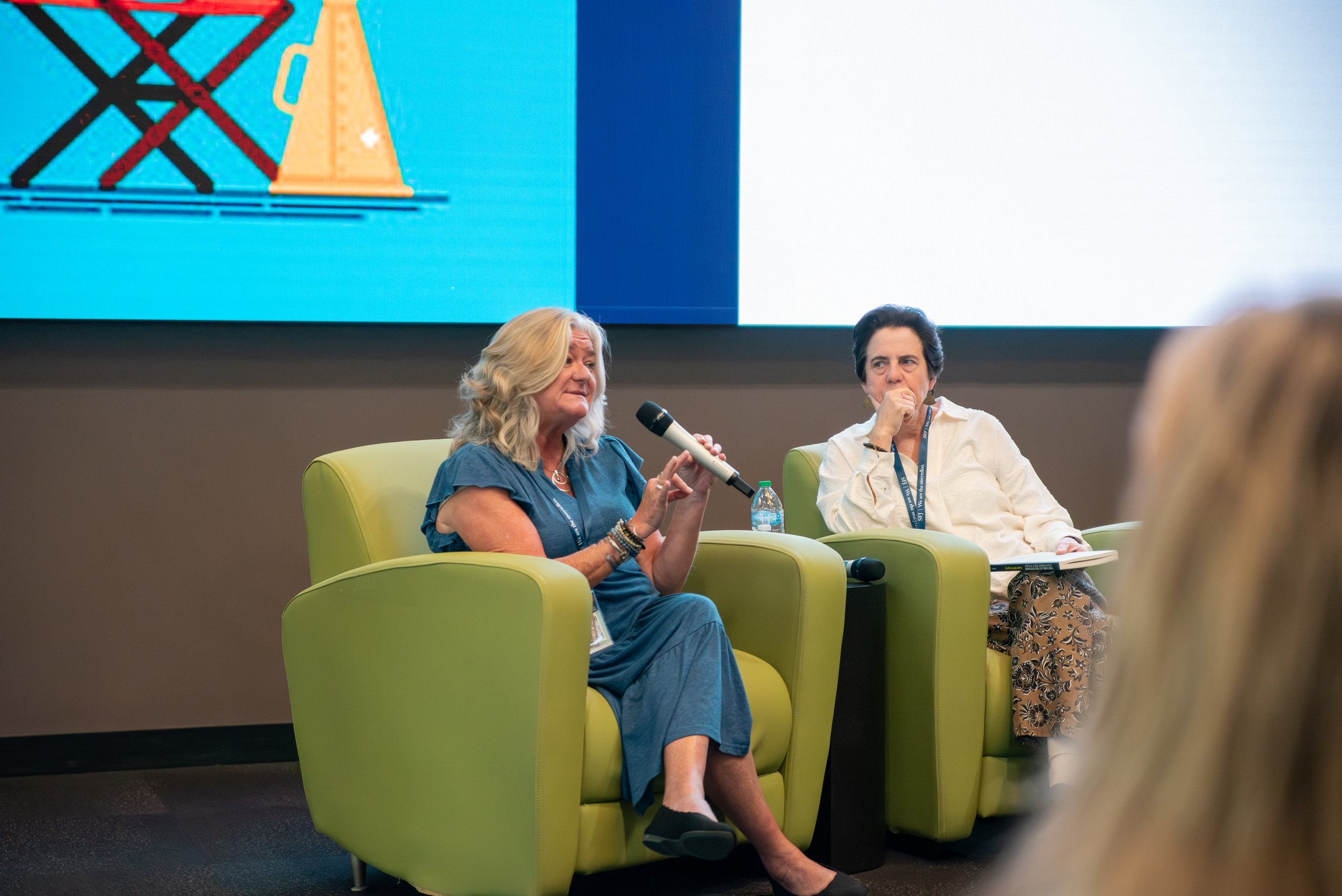
Lane DeGregory and Maria Carrillo gave a session on telling compelling narratives. Photo by Zineb Haddaji, a Hubert H. Humphrey fellow from Djibouti
Lane DeGregory has a blueprint for narrative writing, and it doesn’t involve inserting herself into the story.
“I don’t like first person,” she said. “I don’t like the trend where a lot of narrative is now about the person who’s writing.”
DeGregory was speaking in early November during a panel at the SFJ conference at the Walter Cronkite School of Journalism and Mass Communication at Arizona State University.
DeGregory, a Pulitzer Prize-winning writer at the Tampa Bay Times, was joined by Mario Carrillo, her former editor and a six-time Pulitzer juror, to emphasize the elements of strong narratives — going beyond the what, when, and where of news coverage to the why and the how.
DeGregory, quoting two-time Pulitzer winner Jon Franklin, described narrative writing as “chronology with meaning.” A true narrative, she said, must have the elements to take the readers on a journey with a “moral” at the end.
But first, the writer must have an idea that fits the narrative approach.
DeGregory and Carrillo said they begin by finding a story idea and then shaping and sharpening it. They use a method where you draw a “sun” or a “wheel” — a circle with six to eight spokes. The broad idea, such as “immigration” or “abortion,” is then written inside the circle while related themes or ideas are written along the spokes.
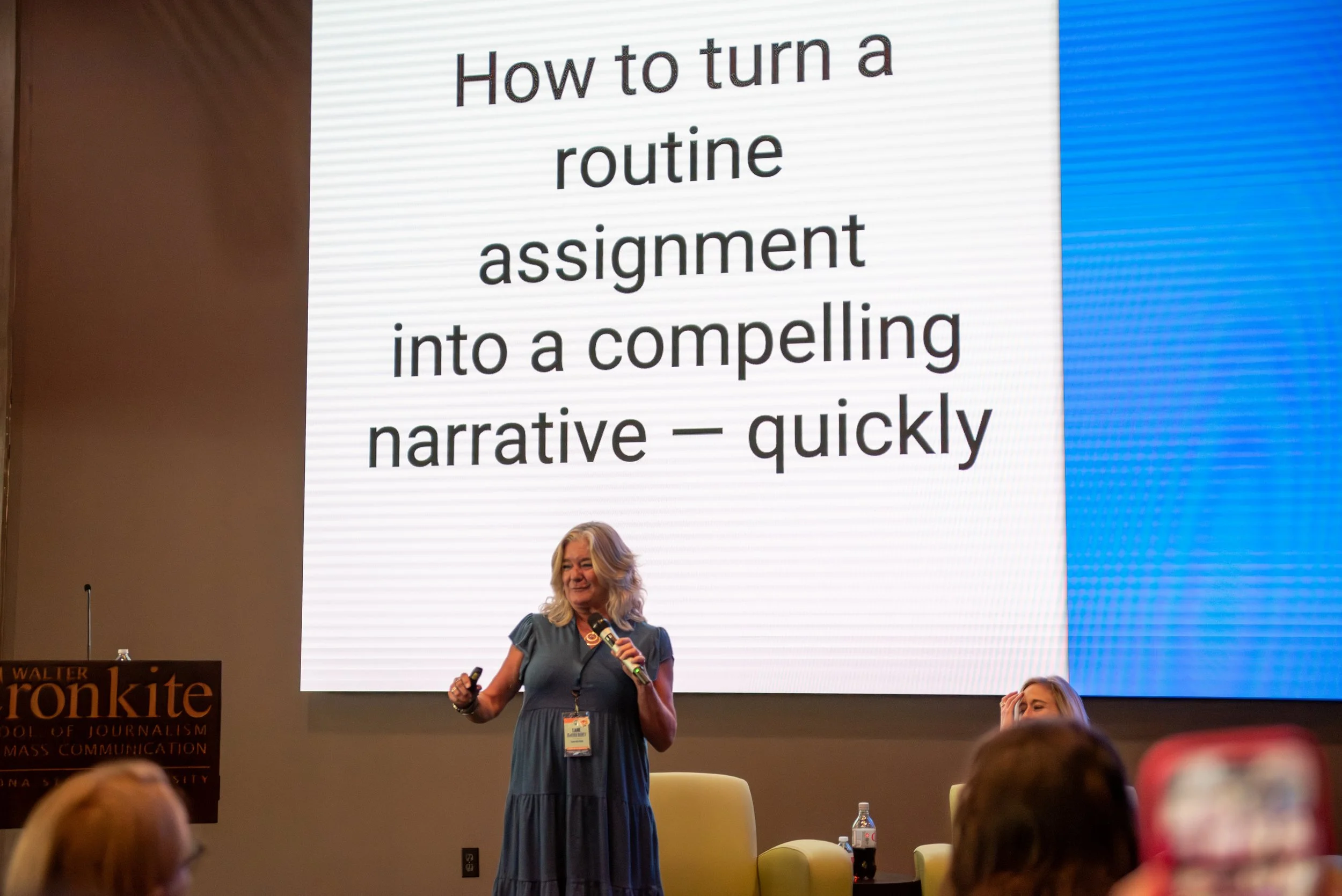
Lane DeGregory, a Pulitzer Prize winner, presented several sessions at the SFJ 2025 conference from Nov. 6-8 at the Walter Cronkite School of Journalism and Mass Communication at Arizona State University. Photo by Zineb Haddaji, a Hubert H. Humphrey fellow from Djibouti
The goal, according to DeGregory, is to tell a story that serves as a “window in” to the issue and allows the writer to “put a face on” how it impacts the community. This approach can also work for smaller or quick-turn-around stories such as “a day in the life” or “an hour in the life.”
It’s part of a formula that DeGregory and Carrillo have developed that can provide a richer context for stories. They call it C.A.S.T., which has four essential ingredients:
Character
Action
Setting
Theme
Find a character willing to let you in — someone open to offering insights, access and honest introspection, about what is required of them. Ask important questions like: “What do you regret?” “What’s at stake for you?” Seek the character’s internal dialogue.
DeGregory also noted that people usually tend to write about someone successful, but she believes that examples of resilience make for better stories.
“People whose dreams don’t come true, people who have to fight through what they thought they were going to be and then figure it out,” DeGregory said. “People who have to go to their life, you know, like when their dreams don’t come true. That’s a more rich place to start mining.”
Once you have a character, you need action. You need to set the scene in a way that transports readers, allowing them to “see” the story unfold. Like a photographer choosing their wide shots and close-ups, a writer should select a perspective.
Carrillo suggests using a one-word, universal theme to organize the story and decide what does and does not belong under that theme.
“You know, that to me is the gift of narrative,” Carrillo said. “It has this way of staying with you, right? Lingering.”
While DeGregory isn’t a fan of nut graphs, she recommends an alternative that helps push the story forward: posing a question to the readers. It keeps readers moving. You also need tension.
“Imagine ‘The Sound of Music’ without the Nazis,” Carrillo said.
Lavanya Paliwal is a student at Arizona State University’s Walter Cronkite School of Journalism and Mass Communication and a journalist, visual artist and designer at The State Press, ASU’s student-run news organization.
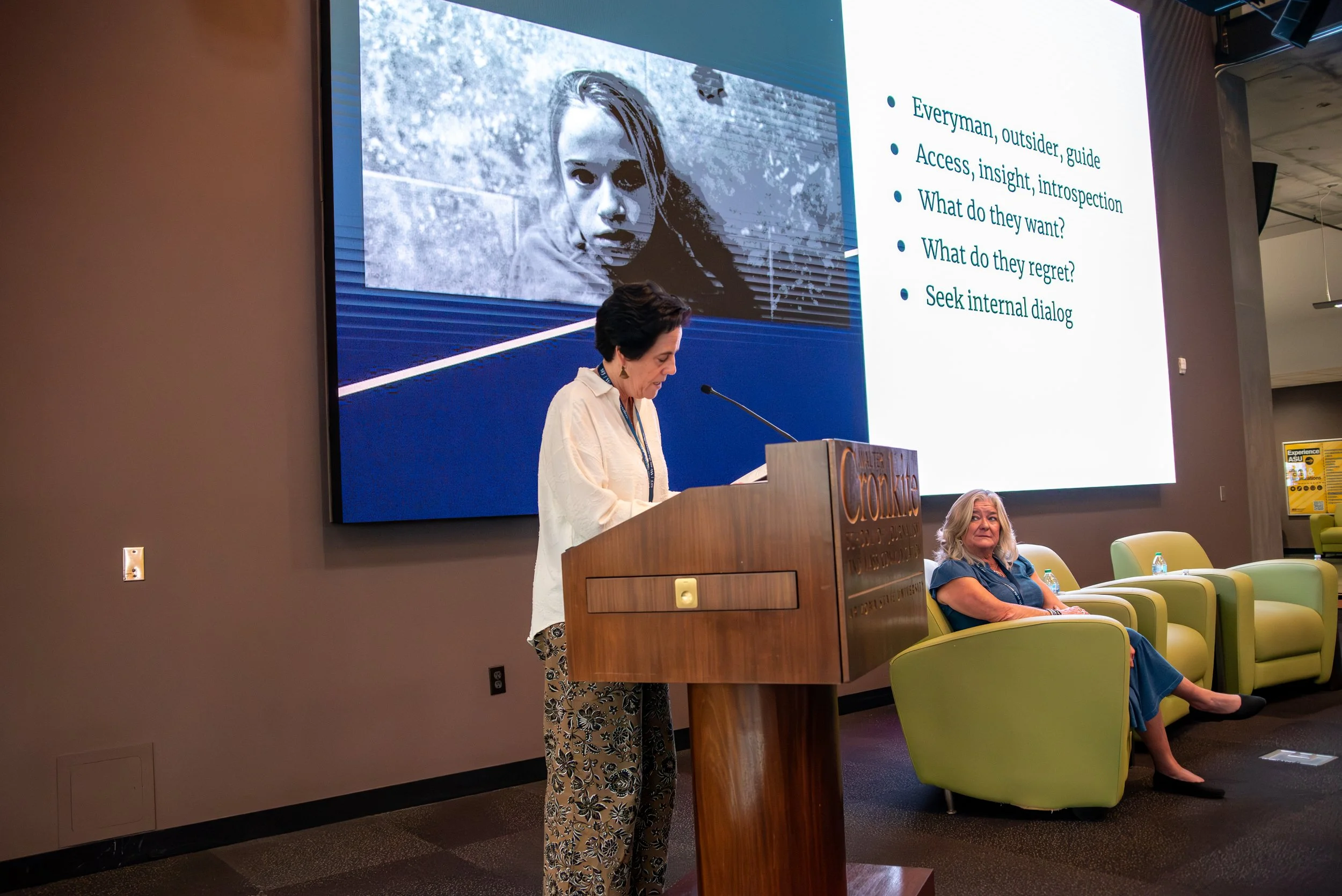
Maria Carillo speaking about Lane DeGregory’s 2008 Pulitzer-winning story, “The Girl in the Window.” The story followed the tension sparked by a tip about Danielle, a 7-year-old girl found in filthy conditions, non-verbal and displaying severe autism. Unable to interview Danielle directly, DeGregory focused on her adoptive parents, gathered police evidence, including 87 photos and official reports. DeGregory wrote a followup story three years later, and again a decade later, showcasing how Danielle’s life evolved after she moved into a group home and began a new chapter. Photo by Zineb Haddaji, a Hubert H. Humphrey fellow from Djibouti