
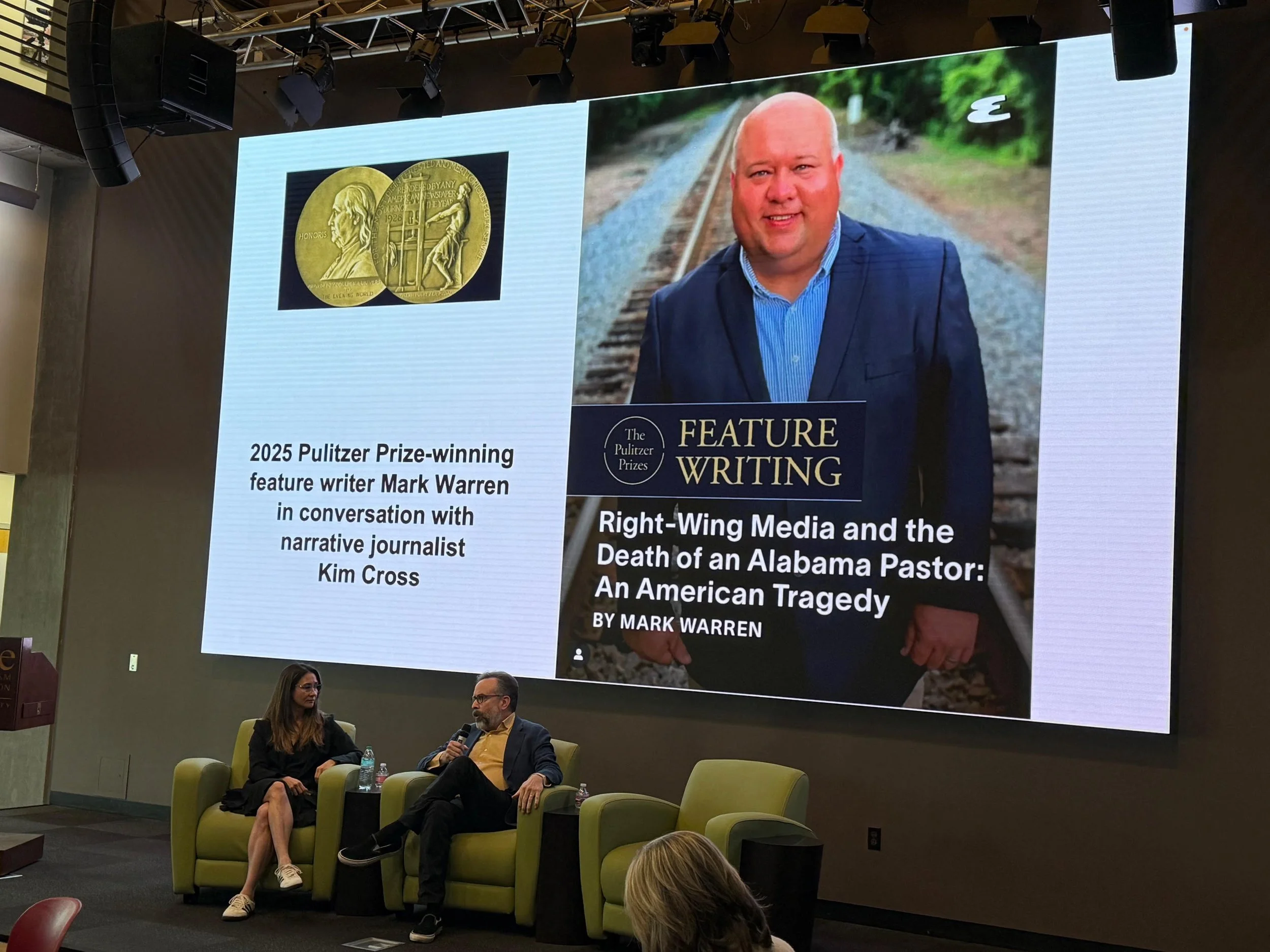
Mark Warren discusses his Pulitzer-winning Esquire story with Kim Cross at SFJ’s national conference on Nov. 7, 2025 at Arizona State University’s Cronkite School in Phoenix. Photo by Laura T. Coffey
Mark Warren won the 2025 Pulitzer Prize in Feature Writing for the Esquire story “A Death in Alabama,” an eye-opening narrative about a big event in a small Alabama town: The death of Bubba Copeland, a Baptist pastor and local mayor who ended his life after his private life was exposed by a right-wing media site.
But there was an unexpected and compelling story behind his article, which Warren shared in early November during the 2025 Society for Features Journalism conference at Arizona State University’s Walter Cronkite School of Journalism and Mass Communication in Phoenix.
Speaking with Kim Cross, a New York Times best-selling author and journalist who wrote an annotation of Warren’s Pulitzer-winning story for Nieman Storyboard, Warren discussed the process of reporting in a small Southern town and avoiding self-fulfilling assumptions as an outsider.
Warren said that earning people’s trust was the most challenging part of his reporting.
“We often encounter people at the lowest point of their lives, and we ask them to allow us to immerse ourselves in the greatest pain of their lives,” he said.
But in the community of Smiths Station, Alabama, where Copeland was the mayor, gaining that trust was even more challenging than usual.
In 2023, 1819 News, a right-leaning website, made aspects of Copeland’s private life public, including his interest in cross-dressing and writing erotic fiction. After Copeland’s story drew intense and intrusive media attention, many locals were resolved never to speak to journalists about the incident again.
Warren began building trust with Copeland’s wary son, Carter, before traveling to Alabama to do additional reporting. By the time Warren arrived in town, Copeland’s son was already asking around to see who might be willing to speak with the Esquire reporter working on the story.
David White, chairman of the board of trustees at First Baptist Church in nearby Phenix City — Copeland’s church — wanted no part of it. The church, along with a large share of the community, however, had placed White in charge of screening Warren. His word was final — if he said no, the whole town would shut its doors.
To gain White’s approval and, consequently, the trust of the town, Warren had to undergo what amounted to a test. That night, White called Warren’s hotel and put him through a tough round of questioning — “sternly, rudeness to the point of anger,” Warren recalled.
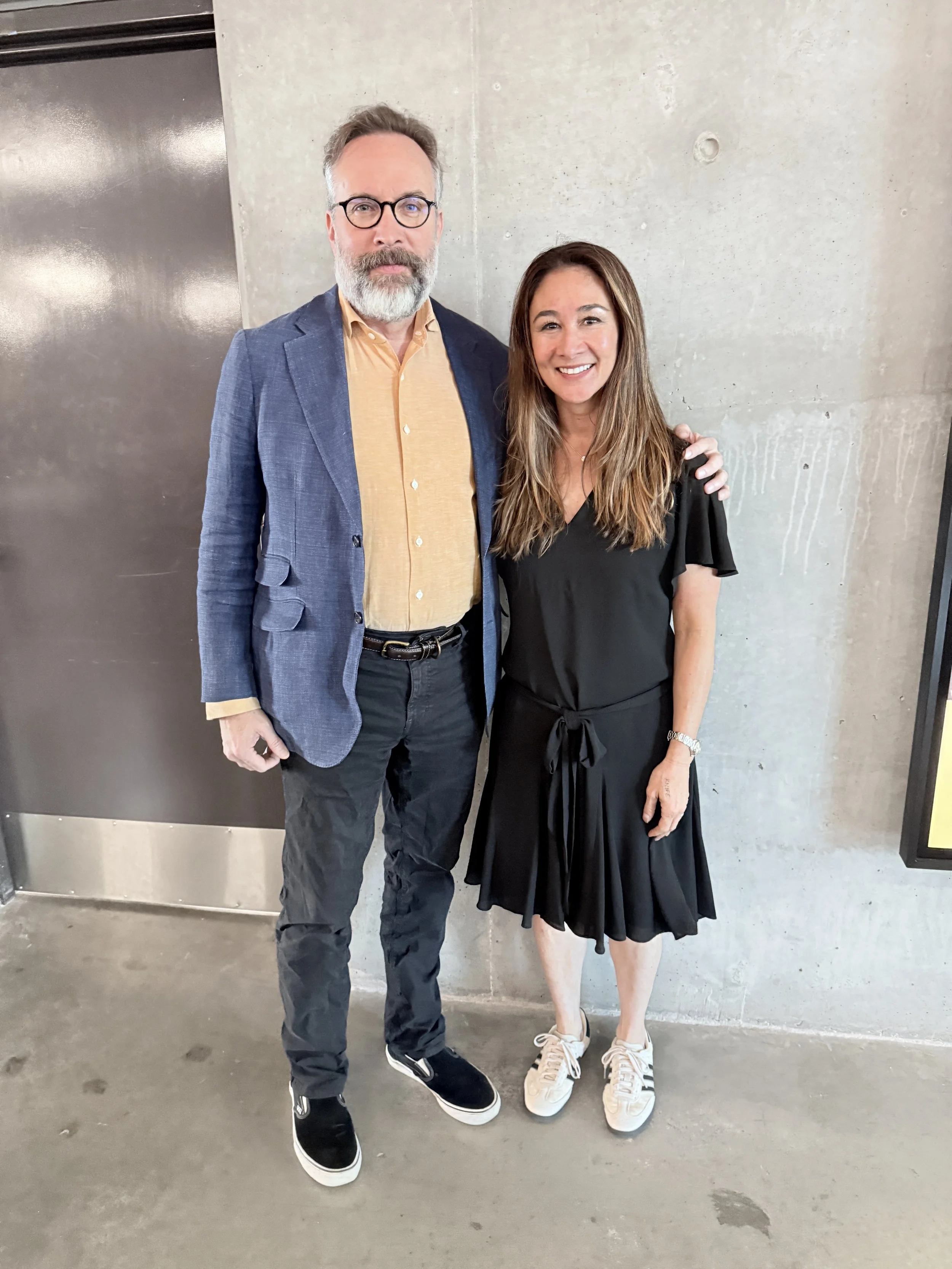
Mark Warren and Kim Cross at the 2025 Society for Features Journalism conference in Phoenix. Photo by Laura T. Coffey
The following day, Warren spent five hours with White, answering more of his questions. By the end, he had “passed the test,” earning not only White’s approval but also a foothold in the town.
“We don’t want 1819 News, the website that had done this, to be the last word on our friend,” White said.
Warren said that if the outlet had done even the simplest background research, the newsroom’s staff would have understood that Copeland was “the heart and soul of these towns.” Instead, Warren said, the outlet relied on a misleading tip and never bothered to learn the context or the community they were writing about.
“We’re in a time of purposeful dehumanization,” Warren said at the conference. “It’s always been our job to humanize, to rehumanize, in this case.”
During Warren’s 28 years as an editor at Esquire, he said he consistently pushed reporters to look beyond routine angles and consider the broader forces shaping their stories. Each piece, in his opinion, should do more than recount an isolated event — it should connect to a larger pattern or cultural moment, featuring a “small story in a large context.”
“Because there’s a larger human experience, it’s what binds us all,” he said. “Telling stories about ourselves to each other is what culture is.”
As Warren wrapped up his reporting in Alabama and returned to New York, the conversations didn’t end. He continued to receive calls from people in Smiths Station. Warren said residents began treating his phone number as a kind of “group therapy,” reaching out in moments when they needed someone to listen. Some called to talk about Copeland, while others said they had something they needed to get off their chest.
The flow of calls indicated how Warren was able to build trust within that community. It underscores the depth of vulnerability that communities offer when they allow a journalist into their most painful moments and the level of trust required to report a story with the emotional weight and impact of “A Death in Alabama.”
Diana Kovalenko is a student at Arizona State University’s Walter Cronkite School of Journalism and Mass Communication and a reporter for The State Press, ASU’s student-run news organization.