
Journalist Moni Basu and editor Jan Winburn have been a powerhouse narrative team for decades, first at The Atlanta Journal-Constitution beginning in 2005, then at CNN from 2010 to 2018.
Now they are training the next generation of storytellers through the University of Georgia’s Low-Residency MFA in Narrative Nonfiction program, where Basu serves as director and Winburn as an instructor and mentor.
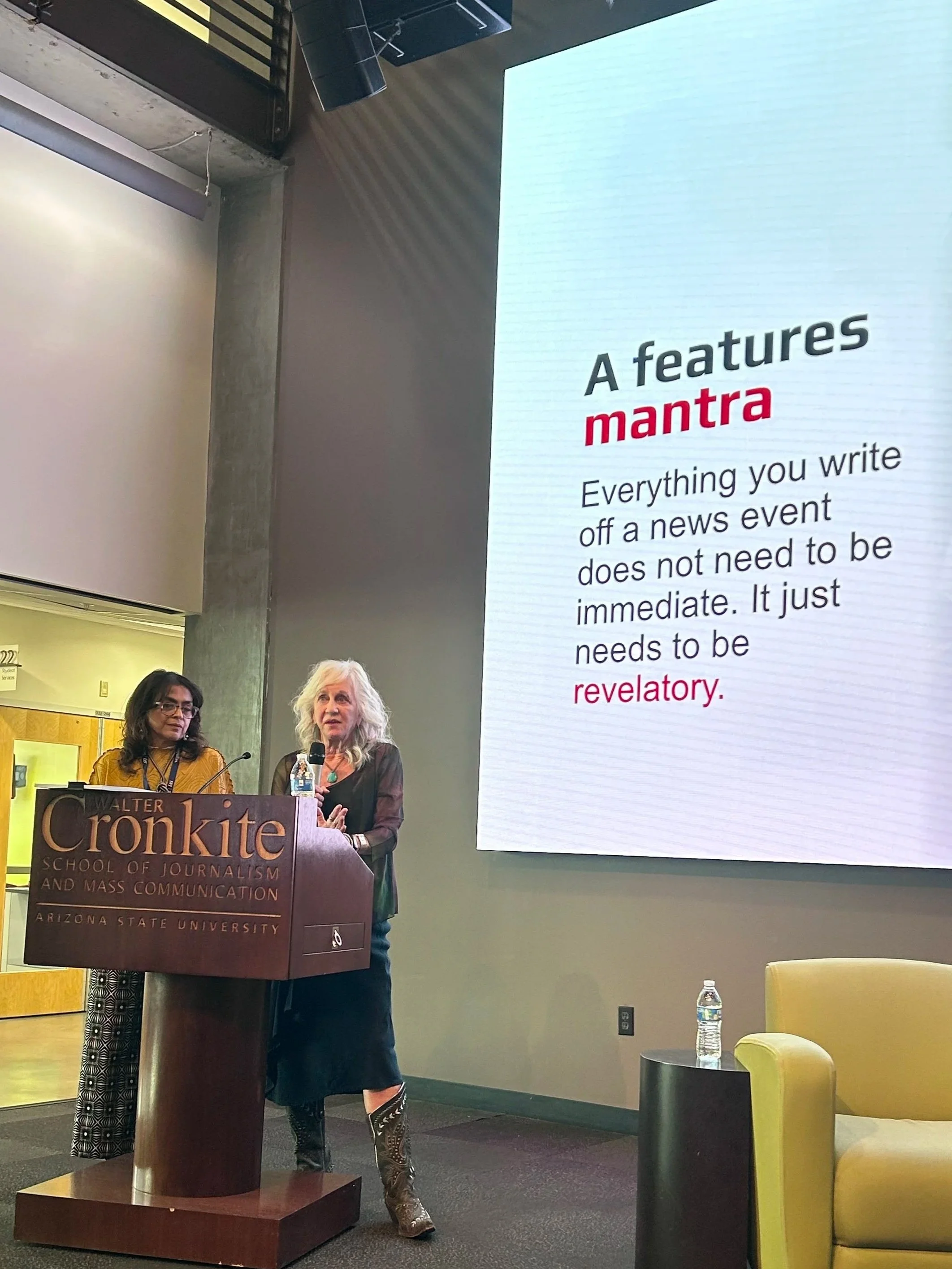
Moni Basu, left, and Jan Winburn speak at the Society for Features Journalism conference at ASU’s Cronkite School in Phoenix on Oct. 23, 2026.
Basu and Winburn spoke at the 2026 Society for Features Journalism conference in Phoenix about the challenges and benefits of features at organizations that prioritize hard news. At many such publications, shrinking budgets have meant fewer feature stories and features sections. However, features still complement hard news by adding depth and nuanced understanding.
“I worked in a place where news was king,” Winburn said. “Features broaden the mission of your news organization to not just bring people the news, but help them really understand the people behind the news.”
One of the challenges they encountered at CNN was getting news-driven managers to understand and appreciate the value of features as an essential component of the news ecosystem. Winburn quoted something James P. Stewart wrote in “Follow the Story”:
“News is something we don’t already know, not necessarily something that just happened,” Winburn said. “That was a complete revelation when I read it years ago. I used it on my bosses.”
Out of that revelation grew their features mantra at CNN: “Everything you write off a news event does not need to be immediate. It just needs to be revelatory.”
“To me, it’s not ‘news you can use.’ It’s news you can feel,” Winburn said. “It touches the heart as well as the head. It changes the focus of news to stories about human nature and human resilience.”
That’s the kind of story Basu searched for after a massive earthquake devastated Haiti in 2010. Covering the disaster as part of a large CNN team, she heard stories about people trapped under the rubble for days. One of those stories led her to Falone Maxi, a 23-year-old woman who was trapped for six days before she was rescued.
Basu wrote about Maxi’s experience in a series of stories, starting with a feature that ran a few weeks after the earthquake. In a subsequent story, Basu drove Maxi around Port-au-Prince to let her witness the widespread damage. A year after disaster, she returned to write about Maxi’s reunion with a fellow victim who had been trapped with her, awaiting rescue.
By following the long arc of recovery, Basu found stories that would have been missed after the breaking news. In doing so, she was able to capture a more nuanced portrait of trauma.
“To me, it’s not ‘news you can use.’ It’s news you can feel.”
“Survival isn’t the end of the story,” Basu said. “What does life look like after, for those living with the consequences?”
In another story, “The Girl Whose Rape Changed a Country,” Basu spent many months reporting on a rape in a distant time and place: India, where Basu was born, and where a teenage orphan was raped in 1972. The girl was known only by her court-given name: Mathura.
Basu was a 9-year-old girl in India when that rape case gave rise to a women’s right movement that changed the country. But what happened to the girl? Decades later, as a CNN reporter, Basu set out to find her.
The resulting longform narrativeb — a devastatingly personal quest — would have turned out very different without the editorial guidance of Winburn, who as a trusted editor and longtime friend gently pushed Basu to write it first person. Why? Because Basu could relate to the victim in a way not every reporter can.
She knew how it felt to be raped.
“Striking a perfect balance between reportage and first person is very hard,” Basu told the Magazine Association of the Greater Southeast. “The piece is not about me, though it reveals a secret I had kept my whole life.”
This story yielded an important insight about how a first-person framework can get readers to care about a story that takes place in a faraway place and time.
“We found first person stories held a level of intimacy with the reader,” Basu said. “Especially when those stories were set in distant lands unfamiliar to the reader. This story is not about me. I’m the guide through the story. But we found those stories did a lot better with our readers.”
Winburn added, “We did a study that looked at dwell time and clicks. The same story told with a little bit of intimacy would jump on the site. When it didn’t have that intimacy, it just didn’t perform as well.”
This kind of story, of course, takes time. Weeks. Months. Sometimes years to report. Which means they run long after the news crews have moved on to the next breaking story. But in their wake, you can often find features with a longer shelf life.
“The news tells us what happened,” Basu said. “Features help us understand what it meant, what it changed, and what remained.”
For more tips from Moni Basu and Jan Winburn:
Reporting trauma: Moni Basu on following an earthquake survivor (Nieman Storyboard)
An editor’s sensitive guide to interviewing victims of trauma (Nieman Storyboard)
Kim Cross is a New York Times best-selling author of “What Stands in a Storm” and “In Light of All Darkness.” She teaches feature writing for Harvard Extension School’s master’s program in journalism, The Larry McMurtry Literary Center in Texas, and the Sawtooth Writing Retreat in Idaho. Find her at @kimcross, on a mountain bike, or in a trout stream.