
From finding javelina experts to understanding what goes wrong in an aviation mishap, artificial intelligence can enhance the art of reporting and storytelling.
That was the major takeaway from a recent interactive workshop led by Shelby Grossman, a professor of practice at the Howard Center for Investigative Journalism at ASU’s Walter Cronkite School of Journalism and Mass Communication.
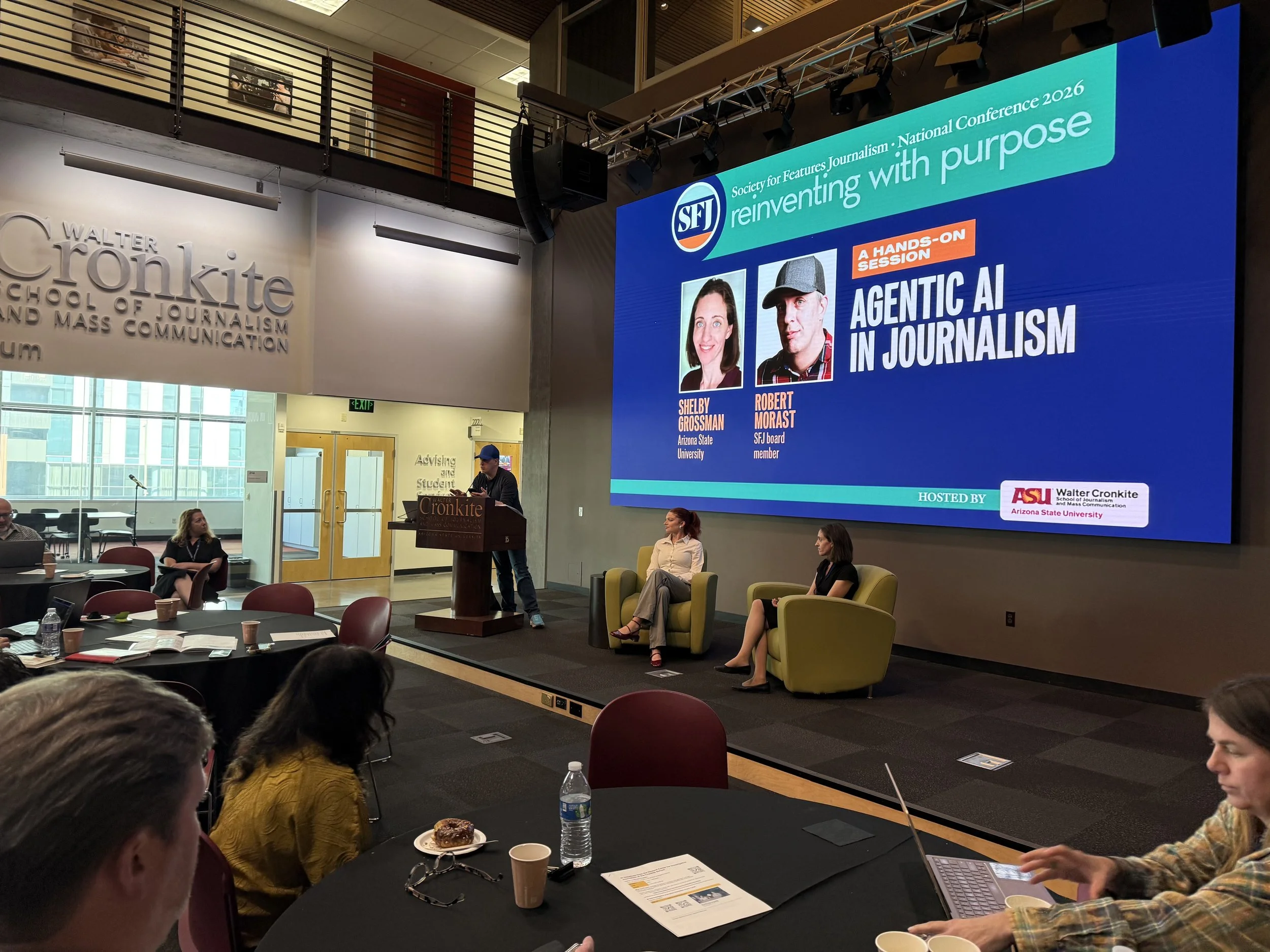
Robert Morast, from left, Lizzie Tomlin, and Shelby Grossman lead an interactive session on using agentic AI.
The Oct. 23 event was part of a conference organized by the Society for Features Journalism.
Grossman talked about how to use both agentic and non-agentic AI in journalism. (Agentic AI is AI with goal-driven reasoning, planning, memory, tool usage, workflow execution and self-evaluation, incorporating a series of agents that can work together. Non-agentic systems operate strictly within predefined rules and instructions. They require explicit commands for each action and cannot make independent decisions.)
At the start, Grossman acknowledged controversies that many associate with AI: “You may have concerns about American privacy, and I just want to acknowledge that those are all valid concerns, and my personal philosophy here is that it can be true that there are all these bad things, but it can also be true that AI can make our work more effective,” Grossman said.
The session included three interactive exercises where participants could prompt ChatGPT to find experts, look through documents and generate story ideas.
A few of the exercises involved giving AI tools direct access to computer folders or websites.
“I know that’s scary, but that’s the trade-off here. AI is most powerful when you can give it access to stuff,” Grossman said.
Fellow panelist Robert Morast, the transformation and technology editor for The San Francisco Chronicle, said that just because AI is being used in the planning process, it does not have to influence the actual story writing.
“People assume that everyone is going to use it to write; nobody wants that,” Morast said. “People use it for fact-checking or research for stories.”
Morast said AI technology helps journalists get pointed in the right direction.
“If you're stuck on an issue or a thought, sometimes it can kind of break you out of that and kind of point you toward a different line of thought that you might not have thought of,” he said.
Morast said he believes that younger, up-and-coming journalists are more willing than many veteran journalists to incorporate AI into the planning process.
“I feel like the younger generations are more likely to incorporate it in how they work every day, in a more organic and normal way,” Morast said. “I think they really understand that this is just part of the tools at their disposal.”
Lizzie Tomlin, a graduate student at ASU, worked with the two panelists to provide a student perspective and explain map data AI research.
“I think we’ve reached the point where it’s in our best interest to get ahead of the tool and utilize it as something that can better help us become better reporters rather than replace us as what we were,” Tomlin said.
While AI can be seen as a useful tool, the panelists said it’s ultimately up to publications to let reporters use it.
“You should always check with your newsrooms and what their policy is around connecting AI to security,” Grossman said.
Grace Lawrence is pursuing journalism with a minor in disability studies at ASU’s Walter Cronkite School of Journalism and Mass Communication.