
Kurt Streeter is a decorated New York Times journalist with a knack for finding stories about the human condition that might otherwise remain in the shadows.
However, Streeter doesn’t describe himself as nosy. He doesn’t seek to uncover closely guarded secrets or catch his sources in any “gotcha” moments.
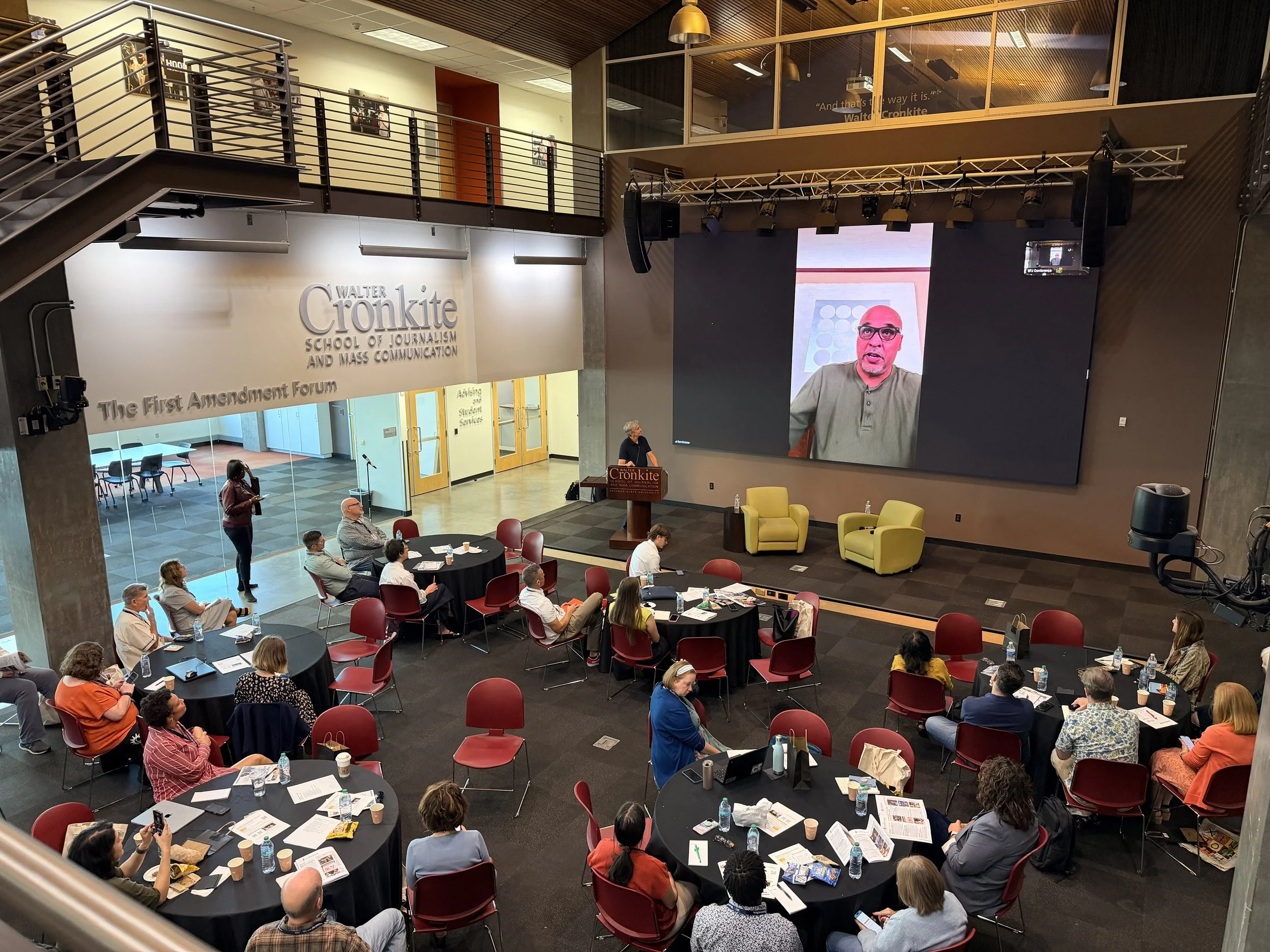
Kurt Streeter and Mark Armstrong speaking at the 2026 SFJ conference. Photo by Kathy Lu
Rather, he finds stories through the close relationships he develops with communities and sources, a method he calls “the fine art of hanging out.”
Speaking at the Society for Features Journalism conference at ASU’s Walter Cronkite School of Journalism and Communication on Oct. 23, Streeter said he developed the phrase in an effort to get young people’s attention. But it succinctly encapsulates the skill that has led to so many of his front-page stories.
Streeter was in conversation with Mark Armstrong, of Nieman Storyboard editor. Due to unforeseen circumstances, Streeter joined the conference via Zoom.
“I really try to understand people and just have a feel for them,” Streeter said. “I really, really want to know them.”
As an example, he talked about “The Girl,” a series he wrote for the Los Angeles Times in 2005.
For more than two years, Streeter followed the lives of Seniesa Estrada, who was around 10 years old when Streeter met her and her father, Joe. Seniesa was a young boxer punching above her weight — at least figuratively — and Joe was her coach. Joe was also a two-strike felon and a proud father.
The longtime journalist said he encountered the family in 2002, in a remarkably unremarkable way, covering a news beat he didn’t particularly enjoy.
At the time, Streeter was covering the MTA, L.A.’s public transportation authority that would soon be rebranded as the Metro. A “boring beat, frankly,” he said, adding that he wasn’t great at the job, which entailed attending board meetings and deciphering labor union strife.
However, he found himself “hanging out” in East Los Angeles at the right time while covering the construction of a rail line.
Streeter was “canvassing the neighborhoods, meeting people, going to shops (and) going into gyms” when he discovered an integral part of the community’s culture: boxing.
East L.A. has been home to a number of great boxers dating back to the 1930s, and “everybody there wanted to be the next Oscar De La Hoya.”
Desperate to cover something more exciting, Streeter would visit boxing gyms in the area after fulfilling his duties on the transportation beat. He, too, was wondering about the next De La Hoya and assumed he was going to look for a 15- or 16-year-old boy destined to be an Olympic champion.
When he arrived at the Hollenbeck Recreation Center’s gym, people pointed him in the direction he expected: strong, aggressive boys.
But Streeter’s attention shifted instead to Seniesa Estrada, “this little waif-like girl in the corner of the gym just absolutely pounding on a heavy bag.”
As a former Division I and minor league tennis player, Streeter thinks his background as an athlete helped him identify Seniesa’s talent.
“I could tell immediately that there was something about the way that she moved that was special,” Streeter said. “Her fluidity and her coordination were just off the charts.”
Holding the heavy bag Seniesa was pounding was her father, Joe, and Streeter invited him to Al and Bea’s Mexican Restaurant, a six-minute walk from the gym.
This was where Joe divulged the details of his turbulent life.
He said he used to be a heroin addict, had been convicted of two felonies and was a former member of the notorious Primera Flats gang. With those two felonies on his record, Joe could have gone to prison for 25 years to life if he got into any more trouble with the law, Streeter said.
Joe wanted to be a good father, and Streeter wondered if his ultra-talented daughter could be his life’s redemption.
Streeter said he immediately wanted to pursue the story.
“I love underdogs,” he said. “I love stragglers, strugglers; I love addicts.”
“He just looked like a junkyard dog,” Streeter said. “He was kind of skinny and rough, but he was really trying to get his life back together.”
One day, Streeter ventured nervously into the office of the then- L.A. Times editor, John Carroll. Streeter hadn’t come up with a formal pitch, but he began to piece the details together for the top boss.
“You can’t screw this up,” he thought — and he didn’t.
The story piqued Carroll’s interest, Streeter said, adding: “His eyes were just lighting up as I was telling him.”
Carroll invited him to sit down, and the pitch turned into a 20-minute conversation. Carroll decided to pull Streeter from the MTA beat so he could focus all of his attention on Seniesa’s and Joe’s story.
He hung out with the father and daughter and was able to get a deeply personal look into their lives, describing, for example, how he saw Seniesa at school, with her friends, worrying about her brothers and dealing with tension with her mom.
During the time Streeter was “hanging out” with Joe and Seniesa, he wasn’t sure if they fully realized the weight of the story he was reporting. They didn’t try to put on a facade for the reporter in their midst, he said; they were their authentic selves around him.
“These are not politicians who are trying to politick their way through an interview,” Streeter said, adding, “they’re just regular people with regular problems. … When people are in really tough situations, a lot of times they just need an ear.”
His work culminated in a five-part Los Angeles Times series. But it also resulted in a special bond between him and his sources.
“When you’re doing this kind of work, you become like a therapist, really,” Streeter said. “I’m sure Joe told me things that he’s never told any other guy or person in his life.”
Streeter said Joe called him when his mother died.
As for Seniesa, she became a world-famous boxer and an undisputed strawweight world champion. She fought for six- to seven-figure purses, ended up signing with De La Hoya’s agency and became everything Streeter thought she would be.
Maybe Streeter did find the next De La Hoya after all.
Wesley Stombaugh is a journalism major at ASU’s Walter Cronkite School of Journalism and Mass Communication.